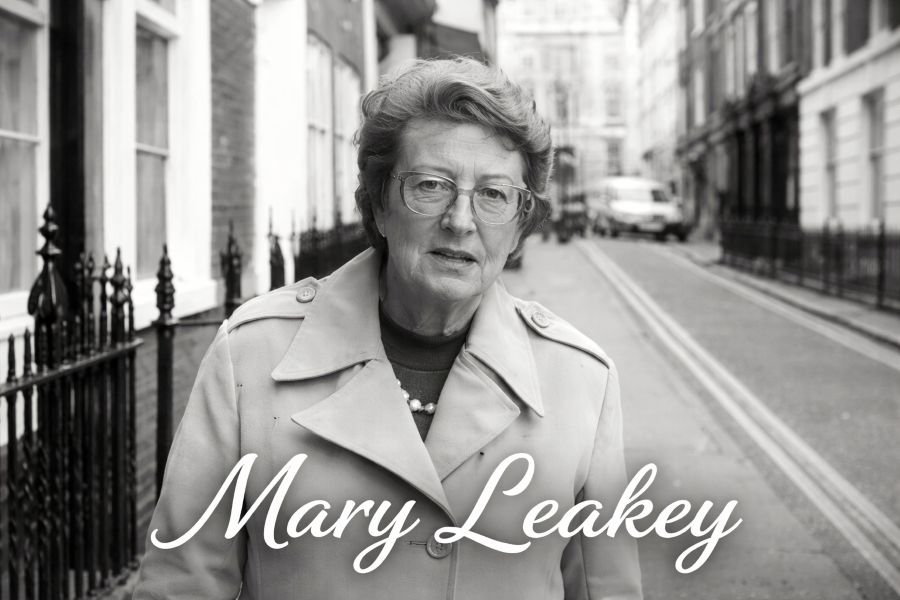
Mary Leakey: The Remarkable Pioneer Who Transformed Human Origins Research
A Powerful Legacy of Discovery, Determination, and Scientific Truth

Introduction
Mary Leakey stands as one of the most influential figures in the history of archaeology and human-evolution research. Her meticulous work, sharp observational skills, and lifelong dedication to field science reshaped how the world understands humanity’s ancient past. As a British paleontologist, she played a decisive role in proving that early human evolution occurred in Africa, a conclusion that changed scientific thinking forever.
Despite her extraordinary achievements, Mary Leakey’s journey was not without challenges. She built her reputation in a field dominated by men and without the advantage of formal academic credentials. Yet her persistence and discipline turned obstacles into stepping stones, making her story both inspiring and intellectually significant.
Quick Bio
| Field | Information |
|---|---|
| Full Name | Mary Douglas Nicol Leakey |
| Known As | Mary Leakey |
| Date of Birth | 6 February 1913 |
| Birthplace | London, England |
| Date of Death | 9 December 1996 |
| Nationality | British |
| Profession | Paleoanthropologist and archaeologist |
| Spouse | Louis Leakey |
| Children | Jonathan, Richard, Philip Leakey |
Early Life and Background
Mary Douglas Nicol Leakey was born in London into an artistic family, with her father working as a landscape painter. Her childhood was unusual and adventurous, as she spent long periods traveling across Europe with her parents. These travels exposed her to museums, prehistoric caves, and ancient cultures at an early age, nurturing a natural curiosity about the past.
The loss of her father during her teenage years marked a turning point in her life. Returning to London, she continued to develop her interests through self-education rather than formal schooling. This independent learning style helped shape her keen observational skills, which later became one of her greatest strengths in scientific work.
Education and Self-Training
Unlike many leading scientists, Mary Leakey did not obtain a university degree. Instead, she built her expertise through practical experience, museum studies, and attending lectures in archaeology and geology. Her artistic ability also played a crucial role, as she became skilled at drawing fossils and artifacts with exceptional accuracy.
This unconventional educational path proved to be an advantage rather than a limitation. It allowed her to focus intensely on fieldwork and hands-on research, giving her a deep understanding of excavation methods and artifact analysis that few formally trained scholars possessed.
Beginning of a Scientific Career
Mary Leakey’s professional journey began in the early 1930s when she worked as an archaeological illustrator. Her detailed drawings quickly gained attention within academic circles, leading to opportunities to participate in excavations. During this period, she met Louis Leakey, a pioneering researcher in human evolution.
Their marriage in 1936 marked the beginning of a lifelong scientific partnership. Together, they moved to East Africa, where they would conduct groundbreaking research that would define their careers and influence generations of scientists.
Major Discoveries and Breakthroughs
One of Mary Leakey’s earliest significant contributions was the discovery of an important primate fossil, which provided insight into early evolutionary relationships. Her careful excavation techniques ensured that fossils were preserved and documented with precision, setting new standards for archaeological practice.
Her most famous discovery came in 1959 with the unearthing of a robust early hominin skull at Olduvai Gorge. This find captured global attention and provided compelling evidence supporting Africa as the center of early human evolution, transforming scientific debate.
Work at Olduvai Gorge
Olduvai Gorge in Tanzania became the central focus of Mary Leakey’s career. Over decades of research, she developed a detailed classification system for stone tools that helped scientists understand the technological development of early humans. Her systematic methods emphasized careful documentation and stratigraphic analysis.
After the death of her husband in 1972, Mary assumed leadership of the research program at Olduvai. Her ability to guide large-scale excavations while maintaining scientific rigor demonstrated her authority and expertise in the field.
The Laetoli Footprints Discovery
In the 1970s, Mary Leakey led a team that uncovered fossilized footprints preserved in volcanic ash at Laetoli in Tanzania. These footprints, dating back more than three million years, showed clear evidence of upright walking, offering crucial insight into early human locomotion.
This discovery remains one of the most important pieces of evidence in paleoanthropology. It provided a vivid snapshot of ancient life and strengthened the understanding of how early hominins moved and evolved.
Publications and Contributions to Science
Mary Leakey shared her findings through several influential books that combined scientific detail with accessible storytelling. Her writings helped bring the story of human origins to a wider audience, bridging the gap between academic research and public understanding.
Beyond her publications, her greatest contribution was her methodological approach. She emphasized precision, patience, and respect for evidence, principles that continue to guide archaeological research today.
Personal Life and Character
Mary Leakey was known for her private and disciplined personality. She preferred the quiet focus of fieldwork over public attention, dedicating most of her life to research in East Africa. Her commitment to scientific integrity earned her deep respect within the academic community.
Her family also became closely associated with the study of human evolution. Her children, particularly Richard Leakey, continued the scientific legacy, further advancing research into humanity’s origins.
Conclusion
Mary Leakey’s life represents the power of determination, curiosity, and scientific rigor. Through her discoveries and leadership, she reshaped the narrative of human evolution and established new standards for archaeological research. Her work demonstrated that careful observation and persistence can lead to discoveries that redefine history.
Today, she is remembered as a pioneering British paleontologist whose contributions continue to influence science and education. Her legacy is not only in the fossils she uncovered but also in the inspiration she provides to researchers seeking to understand humanity’s earliest beginnings.
FAQ
Who was Mary Leakey?
Mary Leakey was a pioneering paleoanthropologist known for major discoveries related to early human evolution, including fossils and ancient footprints.
What is Mary Leakey famous for?
She is best known for her work at Olduvai Gorge and the discovery of the Laetoli footprints, which provided evidence of early upright walking.
Did Mary Leakey have formal academic training?
No, she did not hold a university degree and was largely self-taught through fieldwork and independent study.
What impact did Mary Leakey have on science?
Her discoveries confirmed Africa as the birthplace of humanity and established rigorous standards for archaeological excavation.
When did Mary Leakey pass away?
She died on 9 December 1996, leaving behind a lasting scientific legacy.